

What to Expect from a Greek Home Dinner in Athens

Updated: Jul 14

Discover the Most Authentic Way to Experience Greek Food and Hospitality
When people dream about Greece, they often picture whitewashed islands, ancient ruins, crystal-clear seas, and long dinners shared under the Mediterranean sky. Food is always part of that dream—but many travelers arrive in Athens wondering where they can experience Greek cuisine beyond the tourist restaurants and crowded tavernas.
The truth is that some of Greece's most memorable meals are not found on restaurant menus at all. They happen around family tables, in home kitchens filled with the aromas of recipes passed down through generations, where conversations flow naturally and every guest is welcomed as if they were already part of the family.
A Greek home dinner offers something many travelers don't realize they're searching for until they experience it: a chance to slow down, connect with local people, understand the stories behind traditional dishes, and see Greek culture through the people who live it every day.
Instead of simply ordering food, you become part of an evening built around hospitality, storytelling, and genuine human connection.
If you're planning your trip alone, you may also enjoy our guide to Solo Travel in Athens: Experience the City Like a Local, where we explore authentic ways to discover the city beyond the usual tourist routes.
Likewise, if you're looking for neighborhoods, cafés, and places most visitors never discover, don't miss Top 10 Hidden Gems in Athens That Most Tourists Miss.
Because authentic travel isn't only about seeing famous places—it's about sharing unforgettable moments with local people.
Why More Travelers Are Choosing Home Dining Experiences in Athens
Travel has changed dramatically over the last decade.
Today's travelers are no longer satisfied with simply checking famous landmarks off a list. While visiting the Acropolis remains an unforgettable experience, many visitors leave Athens saying that the moments they remember most happened during conversations, shared meals, and unexpected encounters with local people.
Across the world, travelers increasingly seek experiences that feel personal rather than commercial.
They want to understand how people actually live.
They want to discover family recipes instead of standardized menus.
They want stories instead of scripted tours.
They want to leave with memories—not just photographs.
A Greek home dinner naturally brings all of these elements together.
Unlike a restaurant, where dozens or even hundreds of guests may be dining at the same time, a home dinner creates a relaxed environment where everyone sits around one table, shares food together, asks questions, exchanges travel stories, laughs, and often makes friendships that continue long after the trip has ended.
For many visitors, this becomes the evening that transforms Athens from a destination into a personal memory.
More Than Food
Greek cuisine has always been about much more than eating.
Meals have traditionally been the center of family life.
Birthdays.
Name days.
Sunday lunches.
Religious celebrations.
Summer evenings on balconies.
Village festivals.
Every important moment in Greek life is accompanied by food prepared with care and shared with people we love.
That tradition remains alive today.
When visitors are invited into a Greek home, they aren't simply tasting recipes—they're experiencing one of the country's oldest cultural traditions: filoxenia.
Understanding Greek Filoxenia
There is one Greek word every traveler should know:
Filoxenia (φιλοξενία).
The word combines two ancient Greek roots:
philos — friend
xenos — stranger or guest
Together, they describe a philosophy that has shaped Greek culture for thousands of years.
Filoxenia means welcoming strangers with generosity, warmth, and respect—not because they are customers, but because they are guests.
Historically, offering food, shelter, and kindness to travelers was considered both a moral duty and a source of pride.
Although modern Greece has changed in many ways, this tradition continues inside countless homes across the country.
It's why many visitors are surprised by how naturally conversations begin around the dinner table.
Nobody rushes.
Nobody watches the clock.
The evening unfolds at its own pace.
Questions are encouraged.
Stories are shared.
Laughter fills the room.
And somewhere between the first appetizer and dessert, strangers often become friends.
From Our Table
One of the things that surprises our guests most is how quickly everyone starts talking to one another.
People often arrive as couples, solo travelers, honeymooners, families, or friends from completely different countries. At first, everyone is naturally a little reserved.
Then the first glass of wine is poured.
Someone asks where another guest is visiting from.
Another shares a favorite place they've discovered in Athens.
Before long, the entire table is exchanging recommendations, laughing together, and talking as though they've known each other for years.
Some guests have even planned the rest of their holidays together after meeting during dinner.
It's a reminder that food has always been one of the world's most powerful ways of bringing people together.
What Is a Greek Home Dinner?
A Greek home dinner is exactly what it sounds like—but also much more.
It is an invitation into someone's home to experience Greek cuisine as locals actually enjoy it.
Instead of sitting at separate restaurant tables, guests share one welcoming table.
Instead of choosing from a printed menu, they enjoy a thoughtfully prepared meal inspired by regional Greek traditions, seasonal ingredients, and family recipes.
Instead of simply being served food, guests learn where each dish comes from, how it's prepared, why it became part of Greek culture, and the memories connected with it.
Many evenings also include live cooking demonstrations, conversations about everyday life in Greece, local wines, homemade desserts, and practical recommendations that only residents can share.
For travelers, it becomes an experience that combines:
authentic Greek food,
cultural storytelling,
meaningful conversations,
local hospitality,
and genuine human connection.
It's not simply dinner.
It's one of the most personal ways to experience Athens.
Home Dinner vs Restaurant vs Taverna vs Food Tour
Visitors often ask which dining experience offers the most authentic introduction to Greek cuisine.
The answer depends on what you're looking for.
Restaurant
Restaurants can offer excellent food and professional service, especially when focusing on regional Greek cuisine. However, the experience is primarily centered on the meal itself, with limited interaction beyond your own table.
Traditional Taverna
A neighborhood taverna introduces travelers to classic Greek dishes in a lively local atmosphere. It's a wonderful way to enjoy traditional flavors, although service is naturally designed for many guests rather than personal cultural exchange.
Food Tour
Food tours are ideal for sampling a variety of specialties across different neighborhoods. You'll visit multiple locations in a short time, making them perfect for discovering flavors quickly, though conversations and deeper cultural insights are necessarily brief.
Greek Home Dinner
A home dinner combines authentic cuisine with something much harder to find: time.
Time to ask questions.
Time to hear family stories.
Time to watch dishes being prepared.
Time to understand Greek customs.
Time to meet other travelers.
Time to experience hospitality as locals have practiced it for generations.
For many visitors, that combination turns dinner into one of the defining memories of their entire stay in Athens.
From Arrival to the Last Toast: What Your Evening Looks Like
One of the questions we hear most often is simple:
"What actually happens during a Greek home dinner?"
Unlike a restaurant reservation, where most people already know what to expect, a home dining experience feels unfamiliar to many first-time visitors.
Will it feel awkward?
Will everyone know each other?
Is there a schedule?
Do I need to dress formally?
Will I be expected to participate?
The answer is reassuringly simple.
There is no performance.
No script.
No pressure.
Just an evening that unfolds naturally, much like dinner with friends.
Every home is different, but the heart of the experience remains the same: genuine hospitality, exceptional food, and meaningful conversation.
Here's what a typical evening looks like.
Arriving at a Greek Home

As you arrive, the first thing you'll notice is that this doesn't feel like entering a restaurant.
There is no reception desk.
No waiting staff rushing between tables.
No long queue of people waiting for the next available seat.
Instead, you're welcomed personally by your hosts.
The atmosphere is calm, relaxed, and immediately inviting.
Many travelers tell us that this first moment surprises them the most.
Although they booked an experience, it quickly feels like they have been invited into the home of friends rather than strangers.
Shoes echo softly across the entrance.
The aromas from the kitchen already hint at what's cooking.
Music plays quietly in the background.
The city stretches outside the windows while conversations begin naturally.
Athens suddenly feels much smaller—and much more personal.
From Our Table
Many guests arrive saying the same thing:
"We've never done anything like this before."
Some are a little nervous.
Some wonder whether they'll fit in.
Some think they'll simply enjoy dinner and leave.
Usually, within ten minutes, those worries disappear.
The moment introductions begin, the atmosphere changes completely.
By the time the appetizers arrive, people are already exchanging travel stories and laughing together.
Meeting the Hosts
One of the biggest differences between a home dinner and any other dining experience is the people behind it.
You're not meeting servers following a shift schedule.
You're meeting the individuals who planned the menu, prepared the recipes, selected the ingredients, and opened their home for the evening.
That personal connection changes everything.
Questions that might feel unusual in a restaurant become natural.
Where did this recipe come from?
How do Greek families celebrate Easter?
Why is olive oil so important?
Which island has the best cheese?
How is Greek coffee traditionally served?
These conversations happen organically throughout the evening, making every dinner slightly different from the last.
No two groups ask exactly the same questions.
No two evenings tell exactly the same stories.
A Welcome That Starts with a Drink

Before the first course appears, guests are usually offered a welcome drink.
It might be a glass of local wine.
A refreshing seasonal cocktail.
A homemade aperitif.
Or another traditional Greek beverage depending on the season.
This isn't simply about having something to drink.
It marks the transition from sightseeing to slowing down.
The pace changes.
Phones stay in pockets.
The conversations begin.
For many travelers, it's the first time all day they truly relax.
The Kitchen Is Part of the Experience

Unlike many restaurants, where the kitchen remains hidden behind swinging doors, home dining often invites guests to see food being prepared.
Fresh herbs are chopped.
Sauces simmer gently.
Vegetables are arranged by hand.
Bread is warmed just before serving.
Guests frequently watch dishes come together while asking questions about ingredients, cooking techniques, and family traditions.
Instead of wondering how something tastes so good, they discover why.
The recipes become stories.
The ingredients become memories.
Cooking becomes conversation.
Why Fresh Ingredients Matter
Greek cuisine is often described as simple.
That simplicity is exactly what makes quality ingredients so important.
Excellent olive oil.
Seasonal vegetables.
Fresh herbs.
Local cheeses.
Traditional yogurt.
Mountain honey.
Fresh seafood.
Slow-cooked meats.
Rather than relying on heavy sauces or elaborate presentation, Greek cooking allows each ingredient to speak for itself.
Many family recipes have remained almost unchanged for generations because they never needed changing.
Simple food prepared with care rarely goes out of style.
From Our Table
Guests often ask us which dish is the "most traditional."
The honest answer is that there isn't just one.
Greece has dozens of regional cuisines.
A recipe that feels completely ordinary in Crete may never appear on a family table in northern Greece.
An island specialty may be unknown in the Peloponnese.
That's one of the beautiful things about Greek food.
It's incredibly diverse.
Rather than trying to represent every region in a single evening, we love sharing dishes that each tell a different story about Greece's culinary heritage.
Every Dish Has a Story
One of the greatest differences between eating in a home and eating in a restaurant is context.
In many restaurants, a plate arrives.
You enjoy it.
Then the next one appears.
At a Greek home dinner, every dish becomes part of a larger story.
You might learn that a recipe was prepared every Sunday by a grandmother.
Or that a particular ingredient was traditionally harvested only during certain months.
Or that one dish became associated with weddings.
Another with fasting periods.
Another with village festivals.
Food becomes history.
Culture becomes tangible.
The meal becomes a journey across Greece without ever leaving the table.
More Than a Meal—A Conversation
Perhaps the biggest surprise for first-time guests is how much conversation becomes part of the experience.
Travelers ask about everyday life in Athens.
Locals ask about life in different countries.
Recommendations are exchanged.
Books are discussed.
Music inevitably enters the conversation.
People compare traditions from their own cultures.
Someone remembers a Greek meal from years ago.
Someone else is tasting moussaka for the very first time.
These moments cannot be scheduled.
They simply happen.
And often, they become the memories guests talk about long after they forget exactly what they ate.
Greek Hospitality Isn't a Performance
Hospitality in Greece has never been about perfection.
It's about generosity.
You'll notice that hosts often encourage guests to take another serving.
Another slice of bread.
A little more wine.
One more dessert.
Not because they expect you to eat more—but because sharing abundance has always been part of making people feel welcome.
In many Greek homes, hearing "Are you sure you've had enough?" is practically a tradition.
For visitors, it often becomes one of the most charming aspects of the evening.
Not because of the extra food.
Because of what it represents.
The message is simple:
You're welcome here.
The Meal Begins: A Journey Through Greece, One Course at a Time
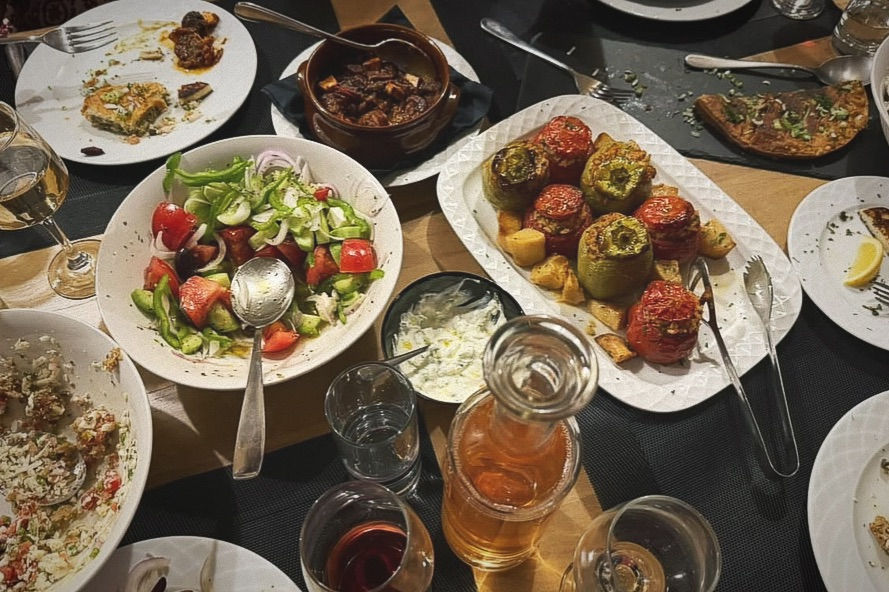
One of the biggest misconceptions about Greek cuisine is that it begins and ends with souvlaki, gyros, or moussaka.
While these dishes are undoubtedly part of Greece's culinary identity, they represent only a small chapter of a much larger story.
Greek cooking has evolved over thousands of years, shaped by geography, climate, trade, local traditions, and family customs. Every island, mountain village, and coastal town has developed recipes that reflect its own history and ingredients.
A Greek home dinner gives you the opportunity to experience that diversity in a way that's difficult to replicate elsewhere.
Rather than focusing on one famous dish, the evening unfolds gradually through multiple courses, each introducing a different aspect of Greek gastronomy.
Instead of simply filling your appetite, every plate expands your understanding of the country's culture.
More Than a Tasting Menu
Visitors sometimes imagine that a multi-course dinner is similar to fine dining, where beautifully plated dishes arrive one after another in small portions.
A Greek home dinner is different.
The goal isn't to impress through elaborate presentation.
It's to share the generosity that has always defined Greek hospitality.
Every course has a purpose.
Some awaken your palate.
Others introduce regional specialties.
Some celebrate seasonal ingredients.
Others are recipes that families have been preparing for generations.
Together, they create a meal that feels balanced, abundant, and deeply personal.
It's not about counting the courses.
It's about experiencing the rhythm of a traditional Greek table.
From Our Table
One comment we hear again and again is:
"We thought we'd be hungry afterwards."
By the end of the evening, guests are usually laughing as they realize they couldn't possibly eat another bite.
Greek hospitality has always been closely connected with generosity.
Serving plentiful food isn't about excess—it's a way of showing care, appreciation, and gratitude to the people gathered around the table.
Many guests leave surprised not only by how much they've eaten, but by how naturally the meal unfolded, without ever feeling rushed.
Discovering Greece Through Regional Flavors
One of the most fascinating aspects of Greek cuisine is that there isn't just one "Greek food."
There are many.
The mountains of Epirus, the islands of the Aegean, the Peloponnese, Crete, Macedonia, Thessaly, and the Ionian Islands each have their own culinary traditions, shaped by local landscapes and centuries of history.
A single evening can introduce flavors inspired by different corners of the country.
You may taste creamy cheeses from mountain regions, recipes influenced by Asia Minor, aromatic herbs from the islands, rich olive oils from the Peloponnese, or desserts that have been served at family celebrations for generations.
Every dish tells a story—not only about food, but about the people and places that created it.
For travelers, this often becomes a journey across Greece without leaving Athens.
The Importance of Seasonal Ingredients
One reason Greek food feels so vibrant is its connection to the seasons.
Traditional home cooking has always relied on what nature provides at the right time of year.
Spring brings fresh herbs, tender greens, peas, and artichokes.
Summer is filled with ripe tomatoes, zucchini, peppers, cucumbers, figs, and fragrant basil.
Autumn offers mushrooms, grapes, pomegranates, chestnuts, and olives ready for harvest.
Winter welcomes hearty legumes, slow-cooked dishes, citrus fruits, and comforting recipes that have warmed Greek homes for centuries.
This seasonal rhythm has never been considered a trend in Greece.
It's simply how people have cooked for generations.
As a result, many home dinners naturally change throughout the year, giving returning visitors a different experience each season.
Olive Oil: The Soul of Greek Cooking

It's impossible to understand Greek cuisine without understanding olive oil.
In Greece, olive oil is more than an ingredient.
It's part of everyday life.
Many families continue to harvest olives from trees that have belonged to them for generations. Bottles of homemade olive oil are shared with relatives, neighbors, and friends, becoming gifts that symbolize care and connection.
Rather than overpowering a dish, good olive oil enhances its natural flavors.
It's drizzled over salads, vegetables, legumes, cheeses, freshly baked bread, and even some desserts.
For many travelers, tasting high-quality extra virgin olive oil for the first time is a revelation.
Its freshness, aroma, and complexity often surprise those who have only experienced mass-produced varieties back home.
From Our Table
One of our favorite moments happens before dinner has even properly begun.
Fresh bread arrives at the table alongside a bowl of exceptional Greek extra virgin olive oil.
Someone dips a piece of bread.
Then another guest follows.
Within seconds, the conversation stops.
People smile.
Someone inevitably says,
"I didn't know olive oil could taste like this."
It happens so often that we've come to expect it.
Sometimes the simplest ingredients create the strongest memories.
Pairing Greek Food with Local Wines

Wine has accompanied Greek meals for thousands of years.
In fact, Greece is one of the world's oldest wine-producing regions, with traditions dating back more than four millennia.
Today, local wineries continue to produce exceptional wines from indigenous grape varieties that many international travelers encounter for the first time.
Rather than focusing solely on internationally familiar labels, a Greek home dinner often introduces guests to wines that reflect the landscapes where they were grown.
A crisp white wine may complement seafood or vegetable dishes.
A smooth red can accompany slow-cooked meats.
A lightly aromatic rosé pairs beautifully with Mediterranean flavors.
The goal isn't formal wine tasting.
It's discovering how food and wine naturally belong together in Greek culture.
Guests often leave with a list of wines they've never heard of—but now hope to find again once they're back home.
Around the Table: Where Strangers Become Friends
As the evening progresses, something subtle begins to happen.
People stop thinking of themselves as separate groups.
The table becomes one conversation.
A couple from Canada recommends their favorite Greek island.
A solo traveler from Australia shares stories from previous adventures.
Someone from the United States asks about everyday life in Athens.
Another guest compares family traditions from Italy, Germany, Brazil, or Japan.
The meal becomes an exchange of cultures.
This is one of the greatest strengths of communal dining.
Food may bring everyone together.
Conversation is what keeps them there.
Many guests later tell us they remember the people they met just as vividly as the dishes they tasted.
Why Solo Travelers Love Greek Home Dinners
Traveling alone offers remarkable freedom, but it can also include moments of loneliness—especially at mealtimes.
A Greek home dinner provides something many solo travelers quietly hope to find: company without pressure.
Instead of sitting alone at a restaurant table, they become part of a shared evening where conversations develop naturally.
There's no need to introduce yourself to strangers in an uncomfortable way.
The shared meal does that for you.
By the end of the evening, many solo travelers have exchanged travel tips, restaurant recommendations, or even plans for exploring Athens together the next day.
If you're visiting the city on your own, our guide to Solo Travel in Athens: Experience the City Like a Local explores even more ways to connect with Athens beyond the usual tourist attractions.
A Favorite Experience for Couples, Families, and Friends
While solo travelers often appreciate the social aspect of communal dining, couples, families, and groups enjoy it for different reasons.
For couples, it offers a slower, more meaningful evening than a traditional restaurant—one where conversation flows naturally and every course feels like part of a shared story.
Families appreciate introducing children to authentic Greek culture through food rather than museums alone.
Friends often describe the experience as the perfect final evening before leaving Athens, bringing together everything they've discovered throughout their trip.
Regardless of who sits around the table, one thing remains remarkably consistent:
Everyone arrives expecting dinner.
Most leave feeling they've experienced something much more memorable.
Why a Greek Home Dinner Often Becomes the Highlight of a Trip to Athens

Ask travelers about the moments they remember most from Greece, and you'll certainly hear about the Acropolis, the sunsets, the islands, or the breathtaking landscapes.
But ask them what they felt during their trip, and the answers are often very different.
They remember the conversations.
The kindness of strangers.
The grandmother who insisted they have one more serving.
The stories behind recipes that had been prepared the same way for generations.
The laughter shared around a dinner table with people they had met only hours before.
These are the memories that stay with us because they are deeply human.
A Greek home dinner is memorable not because it is luxurious or exclusive, but because it offers something increasingly rare in modern travel: genuine connection.
For a few hours, you're not simply visiting Greece.
You're participating in everyday Greek life.
Who Is a Greek Home Dinner Perfect For?
One of the strengths of this experience is its universal appeal. Whether you're traveling alone, with a partner, or as part of a larger group, sharing a meal around a local table offers a different perspective on Athens.
Solo Travelers
A welcoming environment where conversations happen naturally, making it easy to meet fellow travelers while experiencing authentic Greek hospitality.
Couples
A relaxed and meaningful evening that goes beyond a typical restaurant dinner, combining exceptional food with stories, culture, and unforgettable views.
Families
An engaging way for children and adults alike to discover Greek traditions through flavors, customs, and personal interaction.
Groups of Friends
Perfect for celebrating a special occasion, enjoying a memorable final evening in Athens, or simply sharing a unique cultural experience together.
Food Lovers
Ideal for anyone who wants to move beyond tourist menus and discover the regional diversity of Greek cuisine through dishes prepared with care and tradition.
From Our Table
One of our favorite questions at the end of the evening is always the same:
"What surprised you the most tonight?"
The answers are rarely about a specific dish.
Guests usually tell us they didn't expect to spend hours talking with complete strangers.
They didn't expect to learn so much about everyday life in Greece.
They didn't expect dinner to feel so relaxed.
And they certainly didn't expect to leave feeling as though they had spent the evening with friends rather than attending an organized activity.
For us, that's the greatest compliment we can receive.
Tips Before Booking a Greek Home Dinner in Athens
To make the most of your experience, here are a few simple recommendations.
Arrive Curious
You don't need to know anything about Greek cuisine beforehand.
Bring your curiosity, ask questions, and enjoy discovering new flavors.
Come Hungry
Greek hospitality is generous, and meals are designed to be shared at a leisurely pace.
Many visitors are surprised by how satisfying a traditional multi-course dinner can be.
Ask Questions
Some of the best moments of the evening come from spontaneous conversations about recipes, traditions, everyday life, and travel.
Don't hesitate to ask.
Share Your Own Stories
Greek dinners are conversations, not presentations.
Guests contribute just as much to the atmosphere as the hosts.
Slow Down
There's no need to rush through the evening.
Some of the most memorable moments happen between the courses, when stories replace schedules and everyone forgets about the time.
Continue Exploring Athens Like a Local

A Greek home dinner is just one way to experience Athens beyond its famous landmarks.
If you're planning a longer stay, these guides will help you discover even more authentic sides of the city:
Solo Travel in Athens: Experience the City Like a Local — practical advice for independent travelers seeking genuine local experiences.
Top 10 Hidden Gems in Athens That Most Tourists Miss — lesser-known neighborhoods, cafés, viewpoints, and cultural treasures.
What to Do in Athens After Visiting the Acropolis — ideas for making the rest of your day just as memorable as your visit to Greece's most iconic monument.
Best Places to Eat Traditional Greek Food in Athens — an introduction to the city's rich culinary scene and the many ways to experience authentic Greek flavors.
If you're ready to experience Greek hospitality firsthand, you can also explore our Experiences page, discover the Greek Feast, the Ten Course Greek Menu, the Vegan Greek Flavors experience, or visit our Booking page to choose the evening that best fits your trip.
Final Thoughts
Athens is a city that rewards curiosity.
Its monuments tell the story of ancient civilizations.
Its neighborhoods reveal everyday life.
Its markets celebrate local traditions.
But perhaps the most meaningful way to understand Greece is through the people who call it home.
Sharing a meal around a family table has always been one of the country's oldest traditions.
It's where recipes are preserved.
Where stories are passed from one generation to the next.
Where strangers are welcomed with warmth.
And where food becomes much more than something to eat.
Long after your trip has ended, you may not remember every street you walked or every museum you visited.
But there's a good chance you'll remember the evening you sat around a table in Athens, shared traditional Greek food, raised a glass with people from around the world, and experienced the true meaning of filoxenia.
Because in Greece, the best memories are rarely served on a plate alone.
They are created around the table.
Editorial Note from Giannis & Konstantinos
As brothers, we've welcomed travelers from every corner of the world into our home for many years. Every evening is different because every group brings its own stories, questions, and traditions.
What never changes is the joy of watching strangers become friends over a shared meal.
For us, cooking has always been about more than preparing food.
It's about creating an atmosphere where people feel comfortable, connected, and genuinely welcome.
If there's one thing we hope every guest takes home, it's not just a favorite recipe—but a deeper understanding of Greece, its people, and the spirit of hospitality that has shaped our culture for centuries.
---------------------------------------------------------------------------------------------------------------------------
Frequently Asked Questions Before Booking a Greek Home Dinner
Even after reading about the experience, many travelers still have a few practical questions before deciding whether a Greek home dinner is right for them.
Here are some of the most common ones.
Will I Feel Comfortable If I Don't Know Anyone?
Absolutely.
This is one of the biggest concerns for first-time guests, especially solo travelers.
The atmosphere is intentionally relaxed, welcoming, and informal. Conversations develop naturally, and there's never any pressure to participate more than you feel comfortable with.
Many guests arrive knowing nobody.
Most leave having shared stories, laughter, and recommendations with people from several different countries.
Do I Need to Know Anything About Greek Food?
Not at all.
Whether you've eaten Greek food your entire life or you're tasting it for the first time, the experience is designed to be enjoyable for everyone.
Each dish becomes an opportunity to discover new flavors while learning about the traditions and stories behind it.
Curiosity is the only ingredient you need to bring.
Is It Like Eating in Someone's Private Home?
Yes—but in the best possible way.
You'll enjoy the warmth and authenticity of a real home while benefiting from an experience thoughtfully designed for travelers.
It combines the comfort of being welcomed as a guest with the professionalism that comes from years of hosting visitors from around the world.
What Should I Wear?
Comfort is more important than formality.
Most guests choose smart casual clothing that feels appropriate for an enjoyable evening out in Athens.
There is no dress code.
The goal is for everyone to feel relaxed from the moment they arrive.
Can Dietary Requirements Be Accommodated?
In most cases, yes.
Many Greek home dining experiences are happy to accommodate vegetarian, vegan, gluten-free, or other dietary preferences when informed in advance.
One of the advantages of a home kitchen is the flexibility to prepare meals with individual guests in mind whenever possible.
How Long Does the Evening Usually Last?
Unlike restaurant dining, where meals are often finished within an hour or two, a Greek home dinner unfolds at a slower pace.
Most experiences last around three hours, allowing plenty of time to enjoy each course, ask questions, exchange stories, and simply relax.
After all, Greek dinners have never been about eating quickly.
They're about spending time together.
Common Myths About Greek Home Dining
As home dining becomes increasingly popular, a few misconceptions continue to circulate among travelers.
Let's clear up some of the most common ones.
Myth 1: It's Just Another Restaurant in a House
Not at all.
The biggest difference isn't the location—it's the atmosphere.
A home dinner is built around conversation, hospitality, and cultural exchange rather than traditional restaurant service.
You're welcomed as a guest rather than served as a customer.
Myth 2: It Might Feel Awkward
This concern is surprisingly common.
In reality, the opposite usually happens.
Because everyone shares the same table, introductions happen naturally and conversations develop effortlessly.
Many guests tell us they forgot they had only met a few hours earlier.
Myth 3: It's Only for Food Enthusiasts
While food lovers certainly enjoy the experience, many guests book for completely different reasons.
Some want to meet local people.
Others are interested in Greek culture.
Some are celebrating birthdays, anniversaries, or honeymoons.
Others simply want one memorable evening that feels different from traditional sightseeing.
Food brings everyone together, but it's rarely the only reason people remember the experience.
Myth 4: Traditional Food Means Heavy Food
Greek cuisine is often misunderstood.
Although there are rich comfort dishes, everyday Greek cooking is largely based on vegetables, legumes, olive oil, herbs, seafood, grains, and seasonal ingredients.
The Mediterranean diet is internationally recognised not because it's restrictive, but because it celebrates fresh, balanced, and flavourful food.
From Our Table
Sometimes guests arrive saying,
"I'm not sure I'll like everything."
We completely understand.
Trying unfamiliar food can feel intimidating.
But that's one of the joys of sharing a meal in a relaxed environment.
There is no expectation to love every single dish.
Instead, guests discover flavors at their own pace, often surprising themselves.
We've lost count of how many people have said,
"I never thought I'd enjoy this—but it's my favourite dish of the evening."
Moments like these remind us that travel is often about stepping just a little outside our comfort zone.
What Hundreds of Evenings Have Taught Us About Hospitality
After welcoming travelers from all over the world, we've noticed something remarkable.
Despite differences in nationality, language, age, and travel style, many guests describe the evening in remarkably similar ways.
They don't begin by talking about the menu.
Instead, they talk about how the experience made them feel.
They mention feeling welcomed.
Relaxed.
Included.
Curious.
Inspired.
They remember conversations as much as recipes.
They remember laughter as much as flavors.
Many tell us they learned more about modern Greece in one evening around the table than they had in several days of sightseeing.
Others say the experience changed the way they think about Greek cuisine entirely.
Some even return years later—bringing family or friends so they can share the experience with the people they love.
For us, these moments are a reminder that hospitality isn't measured by how many dishes are served.
It's measured by how people feel when they leave.
Every Season Tells a Different Story
One of the beautiful things about Greek home cooking is that it changes with the seasons.
No two times of year feel exactly the same.
Spring
Fresh herbs, tender vegetables, colourful markets, and lighter recipes celebrate the arrival of warmer days.
It's a season filled with freshness and optimism.
Summer
Long evenings, ripe tomatoes, fragrant basil, juicy peaches, refreshing wines, and dinners that stretch into the night make summer one of the most magical times to share a Greek table.
Athens slows down after sunset, creating the perfect atmosphere for outdoor dining and conversation.
Autumn
Harvest season brings olives, grapes, figs, mushrooms, chestnuts, and rich flavours that reflect the changing landscape.
It's a wonderful time for travellers seeking a quieter, more local side of Athens.
Winter
Comforting stews, slow-cooked family recipes, warming desserts, and festive traditions transform the dinner table into one of the cosiest places to experience Greek culture.
The colder months reveal another side of Athens—one that many visitors never have the opportunity to discover.
From Our Table
People often ask us,
"Which season is the best time to experience a Greek home dinner?"
Our answer is always the same:
There isn't one.
Every season brings different ingredients, different conversations, different travelers, and a different atmosphere around the table.
That's one of the reasons we still love hosting after all these years.
No two evenings are ever exactly alike.
And that's exactly how Greek hospitality has always been.


Comments